
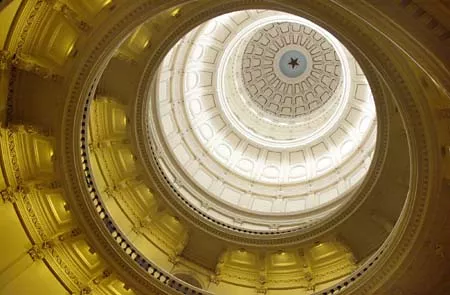
It's been a long, hard 20 years for the biggest state capitol in the nation, but in many ways, these have been the most important. On Dec. 19, 1989, the State Preservation Board approved the first-ever master plan for the Capitol Complex, balancing the value of the original 1888 structure with the fact that it's still a working seat of governance. Capitol curator Ali James explained, "It's really important to make sure that the historic structure survives but also that everyone who works here is able to do what we're entrusted to do." Before then, the maintenance of the site had been haphazard, and the building was becoming overstretched for the needs of a modern Texas. It had taken the big fire of 1983 both to shock Texas out of the idea that the building simply needed looking after and to establish the board to care for it. 1983 was also the year that two Travis County Democrats, then-Sen. (now congressman) Lloyd Doggett and former Rep. Gerald Hill, established the Capitol view corridors, creating dedicated lines of sight along which no new buildings can obscure the dome. If it hadn't been for those decisions, there may not have been much of a Capitol to see or any way to see it. But it was the Nineties that was the decade of great restoration and renovation. James joined the board in 1991 as construction began in earnest of the massive underground Capitol Extension ("I got to see not only the building but also the big hole," she said). Since its completion in 1993, she has seen a massive number of changes in the Capitol Complex, all designed to relieve pressure on the original domed building and to preserve it for visitors and future users. James has been there to see "the exterior and interior of the Capitol get done, the grounds get done in '95 through '97, the Capitol Visitors Center restored, and then [the construction of] a little museum called the Bob Bullock." Now the big projects are complete, but the board and its craftspeople are charged with the complicated upkeep of a massive and historically significant structure in what James calls "the off-season" between sessions. Carpentry, plaster repairs, and grounds maintenance happen every day, all part of what she sees as "this constant love affair with the building to ensure it's presented in the best way possible for visitors and our occupants."