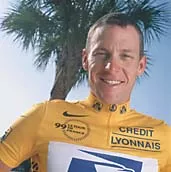
Since roaring across the finish line on the Champs-Elysees in that yellow jersey on July 25, Lance Armstrong has spent a grand total of five days at home in Austin. Five days. That's a mere 120 hours in more than six weeks. Ask him what he's been up to and he sounds like a Continental Airlines flight manifest: Austin to New York to Vail to Washington, D.C., to Las Vegas to Vancouver. And that's just a partial list. It's the kind of life that would leave most folks unable to form the most simple, coherent sentences. Over the past six weeks Armstrong has been on loan to the world, appearing on morning talk shows, yukking it up with Dave on The Late Show, stopping by the White House, competing in a string of exhibition bike races -- including mountain bike competitions -- posing for big fancy glossies like Vanity Fair and Interview, signing autographs at trade shows, fishing with sponsors, and talking to the press. Constantly talking to the press. His Los Angeles-based publicists (Yes, he is so big now, he has L.A.-based publicists) insist they have turned down hundreds of requests for interviews and photo shoots, but Armstrong seems to be everywhere.
Still, during one of those rare trips home, thousands of Austin residents sent out a reminder to the world that while we're willing to let everyone borrow our guy for awhile, he definitely belongs to us. And that's just the way Lance wants it.
Ironically, the city's Aug-ust 9 "Celebration of Lance Armstrong" began much like a more somber day did nearly three years ago. Back on that October afternoon in 1996, Armstrong sat in the conference room of a Congress Avenue law office. There were a couple of reporters on hand, a few cameras, several friends, and a dire message: Armstrong had testicular cancer. It had spread to his brain, his abdomen, and his lungs. He had a slim chance of surviving, let alone ever competing again.
It was kind of a bizzaro deja vu last month when Armstrong was back in the conference room of a Congress Avenue law office. This time there were more than 100 reporters, from 55 media outlets from around the globe. There was a Nike banner shouting, "Just Do It Lance!" hanging behind him, and thousands of excited extended family members waiting to cheer themselves hoarse. Mayor Kirk Watson, who as a fellow cancer survivor feels a special kinship with his Tour de France-winning resident, kicked off the day by bestowing on Armstrong the city's Distinguished Service Medal, inscribed with this sentiment: "For your private survival and your public spirit, so that others may live their dream."
Outside, the temperature at 5pm soared above 101 degrees, but scores of Austin residents were already swarming the steamy streets, staking out a spot for Armstrong's homecoming parade and concert. Austin's downtown looked like an ocean of dandelions -- yellow T-shirts, yellow hats, yellow "Vive le Lance!" placards, yellow balloons hovering overhead. When asked about the victory party more than a month later, Armstrong is still in awe. "I can't believe anyone showed up. It was incredible."
It's an increasingly rare occurrence these days: That harmonic convergence between city and professional athlete. High salaries and capricious team owners make developing long-lasting relationships with sports stars a challenge. But however endangered the species is, there are athletes who seem to embody the spirit of their adopted hometown. Take Mo Vaughn. During his years with the Boston Red Sox, Vaughn wore his Beantown allegiances on his sleeve, insisting on living in the Boston area and frequently sponsoring and participating in community events. (But, of course, Mo Vaughn is a Red Sock no longer.) Or how about Walter Payton? Even as he suffers from a potentially fatal illness, Payton remains as much a part of the Chicago scene now as when he used to crash through defensive lines for the Bears. And Andre Agassi will always be a Vegas boy at heart. Similarly, Austin has Lance.
"The city has always been supportive," says Armstrong. "When I was a young rider and they didn't know what was ahead; as a sick person they put their arms around me and were like, "That's our boy,' and helped me through this. And when I won the Tour, it was like that again. "That's our boy, look what he did.'"
There's no arguing that its a pretty heady time for Texas sports fans. Ricky Williams won the Heisman, Nolan Ryan was inducted into the Hall of Fame (and is bringing a minor league baseball team to Round Rock), the Dallas Stars grabbed the Stanley Cup, the San Antonio Spurs were crowned NBA champs, and the WNBA's Houston Comets just captured its third straight championship.
But despite all this big-time sports success, sports in Austin rarely reach the realm of religious experience that they reach in other cities. Sure, there's football worship. After all, this is Texas. But sometimes it even feels as though the fandom is rather by-the-book ("It says right here in chapter six of How to Be a Texan that we're supposed to like football, so --"). But perhaps what might be perceived by some as an erratic passion for team sports is likely a holdover from Austin's old hippie days: Pro football or baseball or basketball is fine, but it's just too mainstream for us. That's for folks in Dallas or Houston. So it seems rather logical that this city would find its perfect sports icon in Lance Armstrong: a hard-headed kid from a football-worshipping Texas suburb who found joy and success in the unexpected -- the largely European sport of cycling.
The romance began about10 years ago, when Lance Armstrong and the city of Austin were both young up-and-comers. Armstrong found a community of folks he could relate to: athletes who gravitated to quirkier sports and the boosters who loved them.
"The nice thing about this town and its sports is there are a lot of -- I don't know if you want to call them, "alternative' sports but -- there're a lot of cyclists, lots of runners, lots of rowers -- and that's cool," Amstrong says. "It's a different attitude."
Back in 1996, when Armstrong told the world about his illness, his popularity among bicycling enthusiasts -- especially in Europe -- was burgeoning, but few Americans outside the competitive cycling world really had more than a vague idea who this gaunt young man on their television screen was or what he was up against. But Austin residents knew: He was Our Man Lance, the guy who won the 1993 World Championship, competed for the U.S. Olympic team in 1992 and 1996, and had signed a two-year contract with the French team Cofidis. In what is a well-known, but still dramatic, story, the 25-year-old Armstrong started feeling sick in October 1996.
"I'd never been sick before," says Armstrong. "I never had a broken bone in my body. I think the only other time I had been in the hospital was when I was born. But then I got cancer and all that changed."
Today, Armstrong is at peace amid the media blitz in a way few sudden celebrities ever are. He also has a refreshingly blunt brand of honesty, confessing his fears and his shortcomings -- something very few male athletes ever do. For example: He says that in his Other Life, that time before cancer, he never really believed he could win bicycling's most prestigious race.
"I was a one-day rider," he said. "My teammates wanted me to win the Tour, but to be honest with you, in my mind, I didn't believe I could do it. I told them I would win, because that's what they wanted to hear. But I never believed it." He pauses and laughs: "Maybe that's why they dumped me."
Throughout this multi-citymedia tour, despite answering the same 10 questions thousands, no millions, of times, Armstrong never seems to exhale in frustration or roll his eyes or snap. He knows all this attention from the American press and public is not really due to a newfound affection for the sport of cycling. He knows the reason this year's Tour garnered its highest U.S. television ratings ever: "Kid gets cancer. Kid beats cancer. Kid wins Tour de France. It's a comeback story, and people -- especially sports fans -- love a comeback story." Armstrong is not at all snide when he says this. In fact, he seems serenely grateful. After all, almost every time his face is on television or his name is in the paper, the calls start pouring in to the Austin-based Lance Armstrong Foundation, which provides funding and support to cancer patients and survivors.
Some might say "enough with the cancer questions, let's move on." But even when Armstrong kicked off his big homecoming party last month, it was he who put his disease front and center. "The city of Austin, when my disease was diagnosed and I became sick in this city, they became my family," Armstrong said. "They were the ones that reached out. They knew me as Lance, the cancer patient. Now, hopefully they know me as Lance, the cancer patient who won the Tour de France."
He credits the cancer for his calm; even credits it for giving him the strength to win the Tour. It almost doesn't seem fair. This horrible disease that wracked his body, cost him two years of competition, almost cost him his life, and still can momentarily alarm him when he has to go to the doctors for his routine blood tests, gets to play a starring role in his victory story.
Armstrong doesn't wear the title "hero" as comfortably as he donned the yellow jersey in the Tour. "Anybody who lives with cancer is a hero," he demurs. "Anyone who lives through it and fulfills what we call, "the obligation of the cured,' is a hero. But I would never use it to describe myself; that's for others to say."
Armstrong pauses for a moment, then adds with a sly chuckle, "It's not like I'm going to put, Lance Armstrong: Hero on my business cards."